

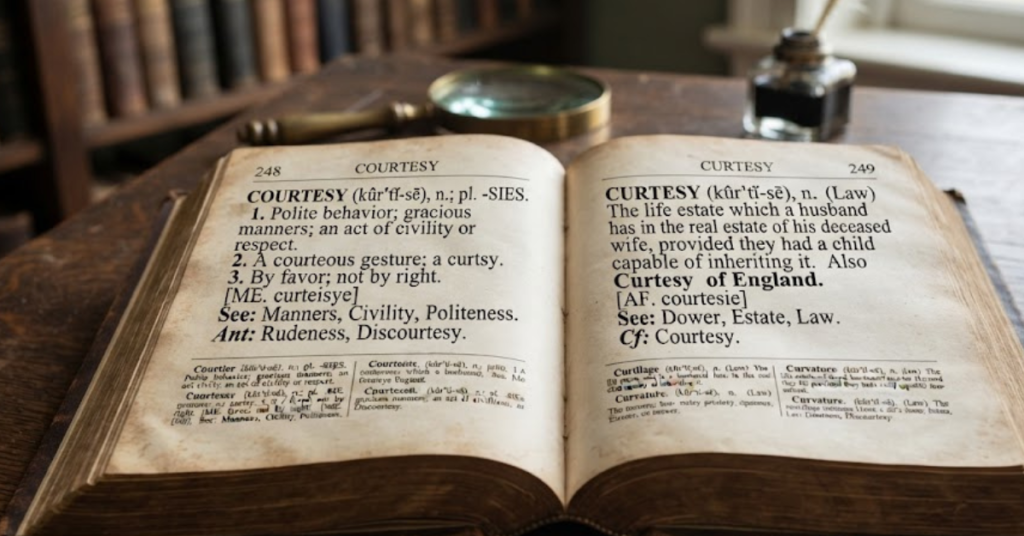
Have you ever typed “curtesy” in a message only to have your spell checker flag it as incorrect? Or perhaps you’ve seen both spellings online and wondered which one is actually right. You’re not alone—this is one of the most frequently confused word pairs in English.
If you’re comparing curtesy vs courtesy, the answer depends entirely on the context. Courtesy is the common English word that refers to politeness, good manners, or a respectful gesture. Curtesy, on the other hand, is a rare legal term with a completely different meaning. In this guide, you’ll learn the distinction, understand courtesy or curtesy meaning, explore real-life examples, and discover how to avoid this common writing mistake.
What Is the Difference Between Curtesy and Courtesy?
The biggest difference is that the two words belong to entirely different areas of English.
| Word | Meaning | Common Usage |
| Courtesy | Politeness, respect, good manners | Everyday English |
| Curtesy | A historical legal right of a widower | Rare legal terminology |
In modern communication, courtesy is almost always the word people intend to write.
Unless you’re discussing historical property law, you probably mean courtesy, not curtesy.
Courtesy Meaning Explained
To understand the comparison, it’s helpful to begin with the more common word.
Courtesy refers to:
- Polite behavior
- Respect toward others
- Thoughtful actions
- Good manners
- Acts of kindness or consideration
It can be used both as a noun and as an adjective.
Courtesy as a Noun
Examples:
- Thank you for your courtesy.
- Showing courtesy to customers builds trust.
- Simple courtesy can brighten someone’s day.
In these examples, the word describes respectful or considerate behavior.
Courtesy as an Adjective
Sometimes courtesy describes something provided as a favor or free of charge.
Examples include:
- Courtesy shuttle
- Courtesy call
- Courtesy copy
- Courtesy vehicle
Example sentence:
The hotel provided a courtesy shuttle to the airport.
Here, the service is offered as a convenience rather than an obligation.
Curtesy Meaning Explained
The curtesy meaning is very different from what most people expect.
Curtesy is an old legal term from English common law. It referred to a husband’s right to use or inherit his deceased wife’s property under certain legal conditions.
Historically, this doctrine was known as “tenancy by the curtesy.”
Today, the word appears almost exclusively in:
- Legal history
- Historical documents
- Academic discussions
- Property law research
Outside those fields, most English speakers never encounter it.
Why Is Curtesy So Rare?
Many legal systems have abolished or replaced the old doctrine of curtesy.
Modern inheritance laws generally provide more equal treatment for spouses, making the historical concept largely obsolete.
As a result, curtesy has almost disappeared from everyday English.
Courtesy or Curtesy: Which Should You Use?
If you’re writing about kindness, manners, or respect, the answer is easy:
Use courtesy.
Examples:
- She thanked everyone for their courtesy.
- Please extend the courtesy of replying promptly.
- Professional courtesy helps maintain good workplace relationships.
Use curtesy only if you’re specifically discussing historical property law.
For the average writer, student, or professional, “courtesy” is almost always the correct choice.
Why People Confuse These Words
The confusion happens because the two words:
- Look almost identical.
- Sound very similar.
- Differ by only one letter.
Many people accidentally type curtesy when they actually mean courtesy.
Spell checkers often catch the mistake, but not always—especially if you’re writing about legal topics where both words exist.
Real-Life Examples of Courtesy
Because courtesy is used every day, you’ll see it in many different situations.
At Work
- Professional courtesy improves teamwork.
- She responded out of courtesy, even though she was busy.
At School
- Students should show courtesy to teachers and classmates.
- Respectful communication begins with courtesy.
In Customer Service
Many businesses promote courtesy as part of their customer experience.
Examples include:
- Courtesy desk
- Courtesy phone
- Courtesy replacement
- Courtesy discount
These expressions describe services offered to help customers or create goodwill.
Real-Life Examples of Curtesy
Although uncommon, you might encounter curtesy in legal or historical writing.
Example:
Under English common law, the husband claimed tenancy by the curtesy after his wife’s death.
This sentence discusses a historical legal doctrine—not politeness.
Courtesy in Common Expressions
The word appears in many familiar phrases.
Common Examples
- Courtesy reminder
- Courtesy call
- Courtesy copy (CC in emails)
- Courtesy notice
- Professional courtesy
- Common courtesy
These expressions all relate to respectful communication or thoughtful behavior.
Common Mistakes to Avoid
Here are some examples of incorrect and correct usage.
| Incorrect | Correct |
| Thank you for your curtesy. | Thank you for your courtesy. |
| She showed great curtesy. | She showed great courtesy. |
| Common curtesy is important. | Common courtesy is important. |
| Professional curtesy matters. | Professional courtesy matters. |
Unless you’re writing about historical law, replacing “curtesy” with “courtesy” is almost always the right correction.
How to Remember the Difference
A simple memory trick can help.
Think of the word court.
Good manners and respectful behavior are often associated with being courteous, especially in formal settings. Both court and courtesy share a similar spelling pattern, making it easier to remember the correct word.
Meanwhile, curtesy belongs to legal history rather than everyday language.
Why Courtesy Still Matters Today
Courtesy isn’t just about saying “please” and “thank you.” It plays an important role in personal and professional relationships.
Showing courtesy can:
- Improve communication.
- Build trust.
- Reduce misunderstandings.
- Create a positive first impression.
- Strengthen workplace relationships.
Whether you’re sending an email, helping a customer, or meeting someone new, small acts of courtesy often leave a lasting impact.
Key Takeaways
- Courtesy means politeness, respect, or considerate behavior.
- Curtesy is a historical legal term related to inheritance rights.
- Most people should use courtesy in everyday writing.
- Confusing the two is common because they look and sound similar.
- Remember that courtesy belongs to modern English, while curtesy belongs mainly to legal history.
Frequently Asked Questions
What is the difference between curtesy and courtesy?
Courtesy refers to politeness, respectful behavior, or thoughtful actions. Curtesy is an old legal term describing a widower’s historical property rights under common law.
Which spelling is correct: courtesy or curtesy?
If you’re talking about manners or kindness, courtesy is the correct spelling. Curtesy is only correct in specific historical legal contexts.
What does curtesy mean?
Curtesy is a legal term from English common law referring to a husband’s right to use or inherit his deceased wife’s property under certain conditions. It is rarely used in modern English.
What does courtesy mean?
Courtesy means showing respect, politeness, and consideration toward others. It can also describe a service or favor provided free of charge.
Why do people misspell courtesy as curtesy?
The words are nearly identical in spelling and pronunciation, making them easy to confuse. Most misspellings happen because people are unfamiliar with the rare legal meaning of curtesy.
Is curtesy still used today?
Yes, but only in legal history, academic writing, or discussions of historical property law. In everyday conversation and writing, courtesy is the word almost everyone needs.
Conclusion
Understanding curtesy vs courtesy is easier once you know that these similar-looking words have completely different meanings. Courtesy is the everyday word that describes politeness, respect, and thoughtful behavior, while curtesy is a rare legal term rooted in historical property law.
The next time you’re deciding between courtesy or curtesy, remember your context. If you’re thanking someone, describing good manners, or referring to a respectful gesture, courtesy is almost certainly the correct choice. Mastering this distinction will make your writing more accurate, professional, and confident.